

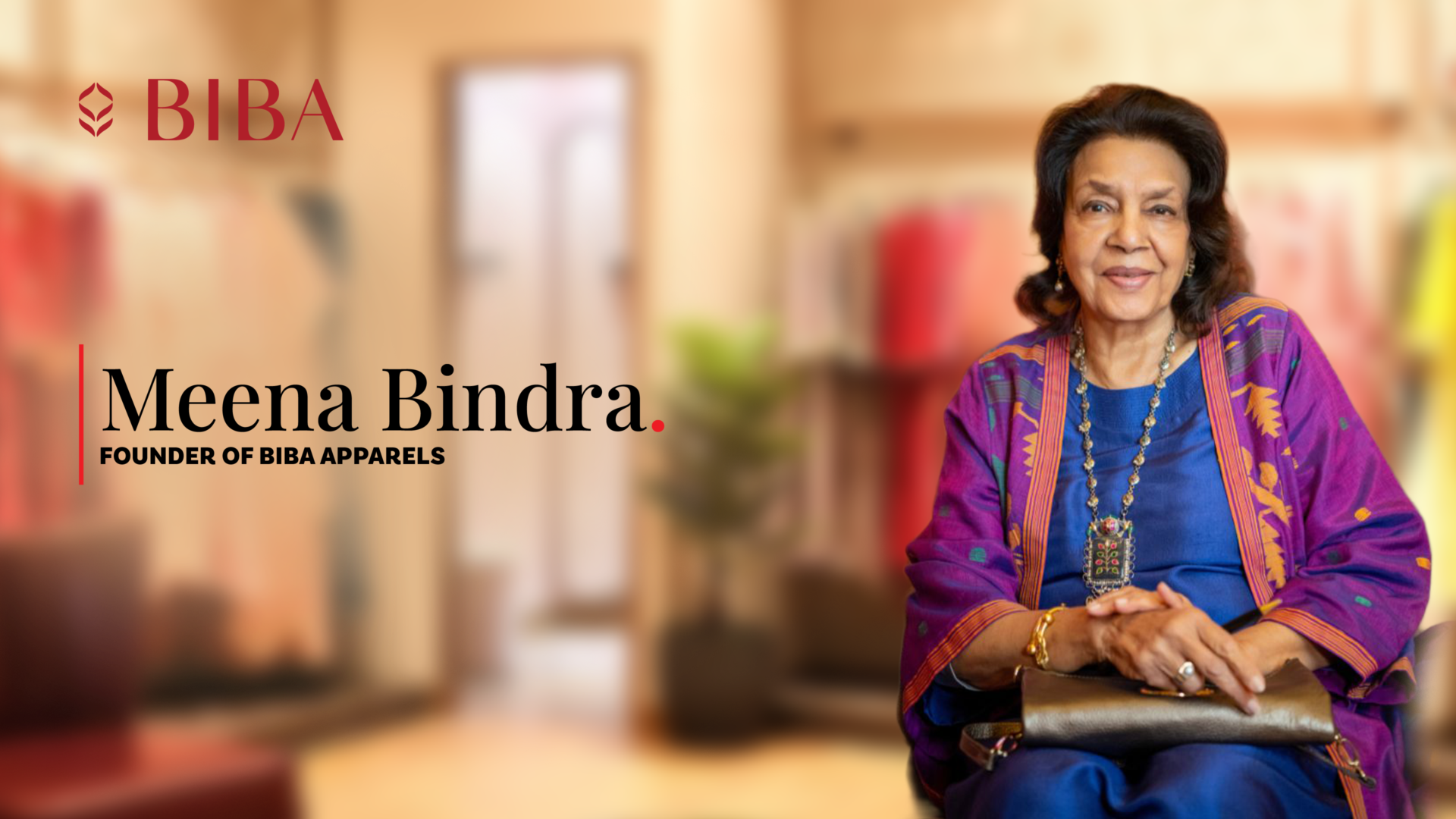
When most women of her generation were content with being homemakers, she quietly stitched her way into India’s fashion history. With just ₹8,000 in hand and a dream in her heart, Meena Bindra transformed the way Indian women bought ethnic wear. She was nearly 40, with no business plan or backing, yet she dared to ask a question no one else had asked: Why shouldn’t ethnic suits be as easy to buy as western clothes? That single thought became Biba, a brand that today defines ready-to-wear ethnic fashion for millions of Indian women.
Born into a business family in Delhi, Meena grew up surrounded by enterprise, though she never imagined herself as a businesswoman. After graduating from Miranda House, she married young to a Naval officer and stepped into the traditional role of wife and mother. For nearly two decades, her life revolved around family duties, transfers, and raising her two sons. But when her children went off to boarding school in the late 1980s, she found herself at a crossroads.
It was during this time that the spark of entrepreneurship was lit. “I had a lot of time on my hands. I didn’t play mah-jong. I thought I should earn a little extra pocket money,” she said. What began as a simple thought of keeping herself occupied would soon alter the course of Indian fashion retail forever.
Like every visionary, Meena’s journey began with a problem she faced herself. Shopping for ethnic wear in those days was an exhausting process, choosing fabrics, running to tailors, waiting weeks for stitching, and still ending up with poor fits. She wondered why Indian women couldn’t enjoy the same convenience that western wear shoppers did, walk into a store and buy a ready-to-wear outfit.
With ₹8,000 borrowed from a bank, she bought fabrics, designed her first batch of salwar-kameez suits, and got them stitched at home. The earliest buyers were wives of her husband’s colleagues. To her delight, the first 80 suits sold out quickly, and word of mouth spread like wildfire. Yet, her efforts weren’t without challenges. Many around her questioned why a Navy officer’s wife should engage in business. Some advised her to give it up. But Meena persisted, fueled by conviction. “Never think you can’t do it. If I could do it, anyone can do it,” she has often said.
From those first stitched suits, Biba was born, a Punjabi word meaning “pretty woman.” The name was as simple and graceful as her vision. What made her creations stand out was the unique blend of traditional Indian aesthetics with contemporary silhouettes, designed to flatter and empower the modern woman.
As demand grew, Meena moved from home tailoring to larger wholesale orders. She recalls that in the early years, “Things kept falling into place. I never had to market myself. At first, it was just ‘Mrs. Bindra’s suits.’ I didn’t even have bills to give my customers.” But professionalism soon followed. By the 1990s, she had set up a small office in Mumbai, employed tailors, and began supplying to leading retail outlets across India.
Her elder son joined the operations, managing logistics and accounts, while Meena focused on design. In 1997, her younger son Siddharth entered the business, and together they shifted Biba from being a supplier brand to a full-fledged retail label. The launch of Biba’s own standalone stores in Mumbai malls in the early 2000s was a turning point. Sales skyrocketed, and Indian women flocked to buy ethnic wear off-the-rack like never before.
The brand’s visibility soared further when Bollywood came calling. Biba dressed heroines in over 40 films, subtly cementing its image as aspirational yet accessible fashion. By the mid-2000s, Biba had become a household name, a trusted companion for festivals, weddings, and everyday elegance.
From an ₹8,000 loan to a brand worth hundreds of crores, Meena Bindra’s story is nothing short of remarkable. Today, Biba has over 400 stores across India, and for decades has enjoyed annual revenues in the hundreds of crores. Its collections are sold in malls, high streets, and online, making it a household name in both metros and small towns.
The brand has also been a pioneer in ethnic fashion retailing, introducing concepts like mix-and-match kurtis and Bollywood collaborations long before they became mainstream. Its ability to blend tradition with modernity has given it an edge over competitors, while its loyal customer base spans three generations of Indian women.
Meena herself has been widely recognized for her role as a pathbreaking woman entrepreneur. She chronicled her inspiring journey in her memoir, A Stitch in Time, The Biba Story, launched in 2024, dedicating it to her grandchildren. At the launch, attended by dignitaries including Smriti Irani, she reflected on her career with characteristic humility, saying, “I never planned to build an empire. I only wanted to create something women could truly wear and love.”
Behind the brand is a woman who never lost touch with her roots. Despite scaling a business empire, Meena remained grounded in her family values. She often credits her sons for scaling the business while she focused on the creative side. She is known to be deeply attached to her family, balancing her entrepreneurial pursuits with the joy of being a mother and grandmother.
Her life is also a testimony to the fact that entrepreneurship doesn’t always have to begin in youth. She started at 39, with no formal training in fashion or business, yet built one of India’s most recognizable brands. That alone has made her a role model for countless women who hesitate to start late in life.
From her Mumbai living room to hundreds of stores across India, Meena Bindra’s journey embodies the spirit of resilience, vision, and creativity. She didn’t just create a business; she created a category. Before Biba, ready-to-wear ethnic suits were almost unheard of. Today, they are a staple across the Indian fashion industry.
Her legacy is not just in the stores or revenues, but in the confidence she gave Indian women, to embrace tradition while stepping boldly into modernity. As she often says, “I rely on my own sensibilities: simple, elegant, wearable design.” Those sensibilities have shaped a brand that continues to define ethnic fashion for millions.
Even as she has passed the operational reins to her sons, Meena remains the creative heartbeat of Biba. Her story is more than just a business success, it is a powerful reminder that sometimes the most transformative ventures begin with everyday frustrations, and that a quiet determination can stitch together empires.
In a world where startups are often associated with the young and restless, Meena Bindra stands tall as proof that entrepreneurship has no age, no perfect timing, and no boundaries. What it requires is courage, conviction, and the willingness to take the first stitch. And in doing so, she has not just built Biba, but has woven herself into the fabric of India’s entrepreneurial legacy.
